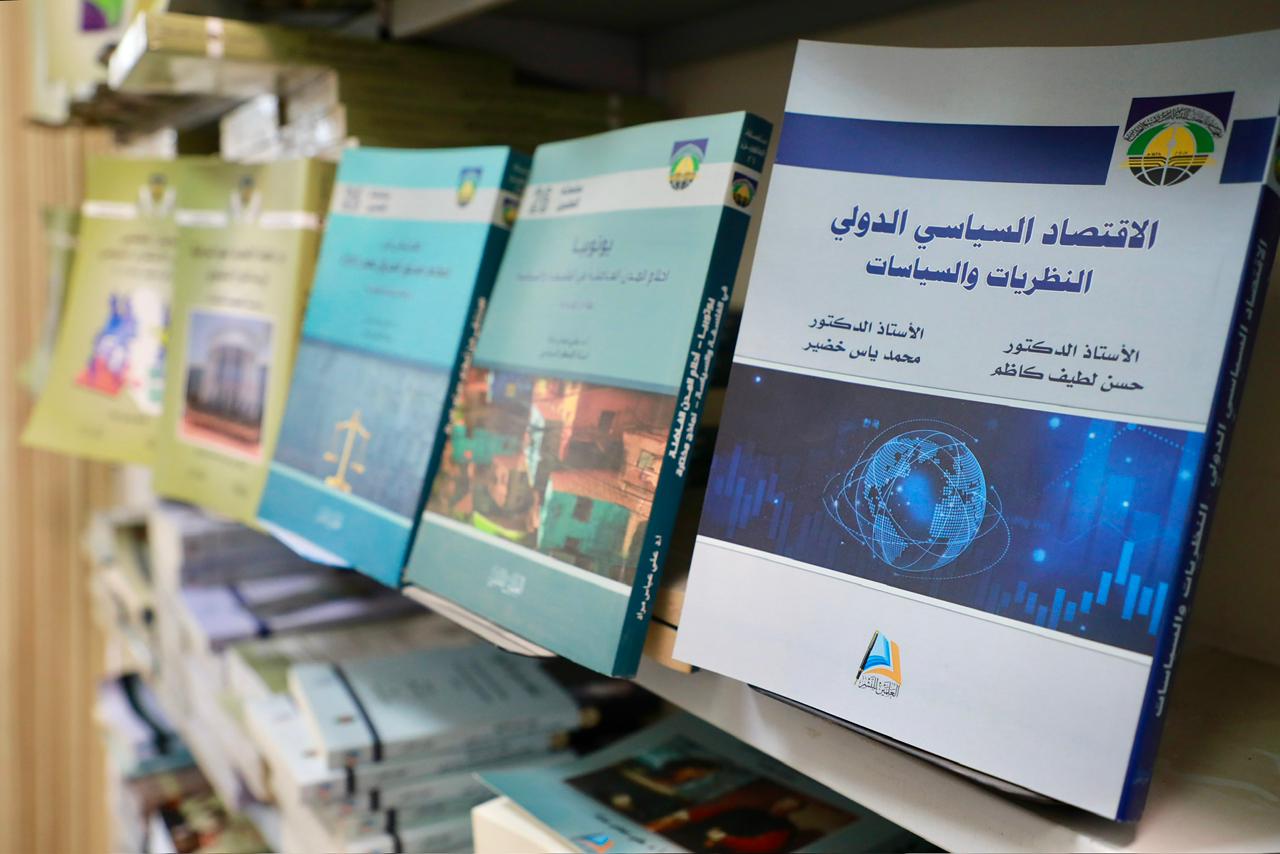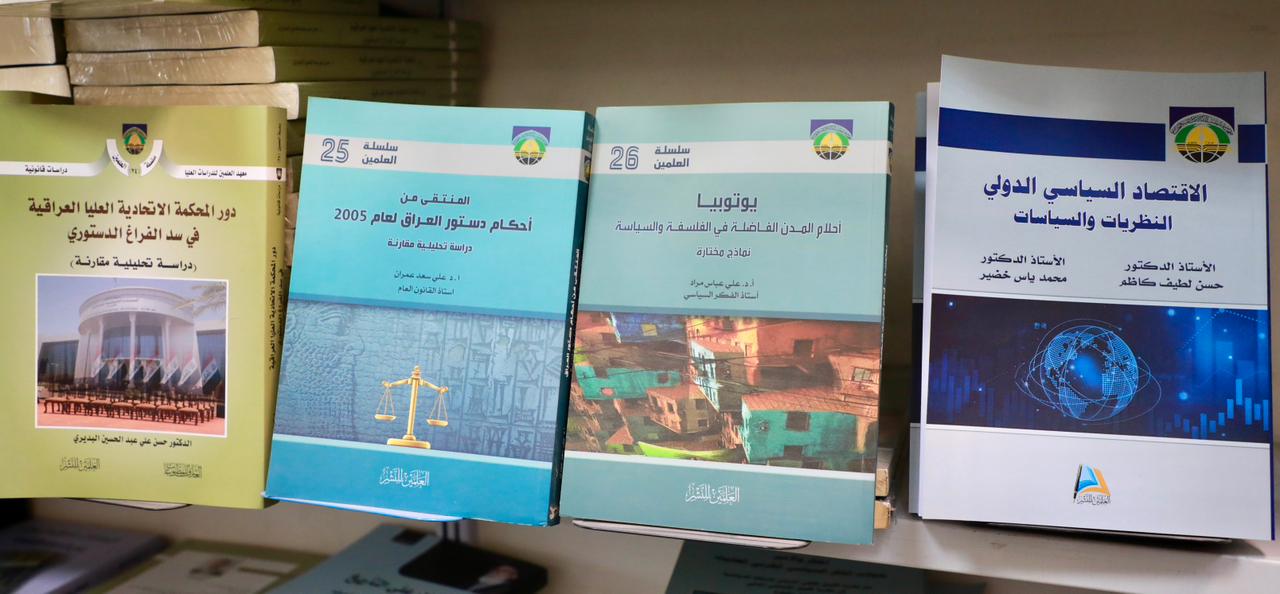
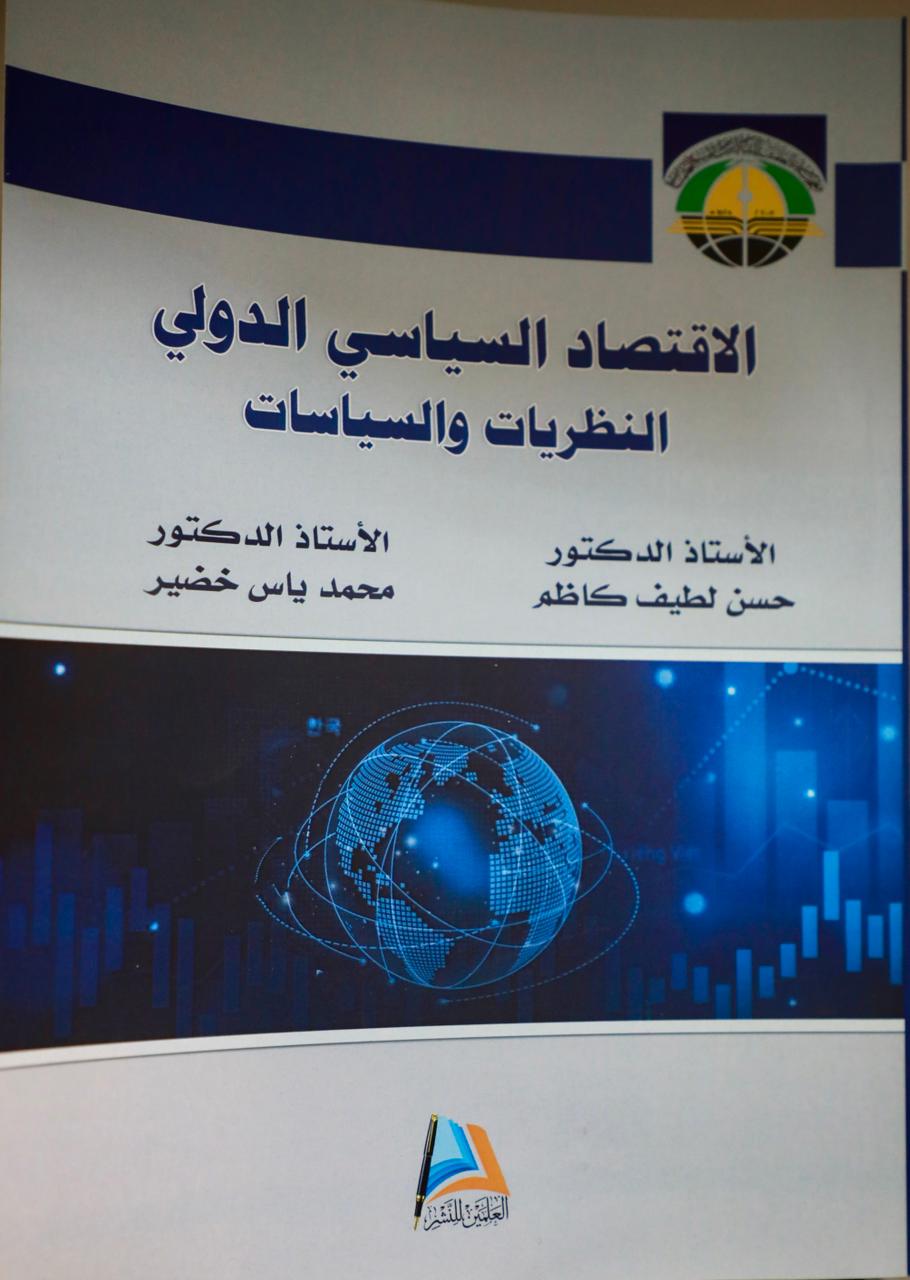
A new book entitled “International Political Economy: Theories and Policies” has recently been published by Dar Al-Alamein Publishing House at Al-Alamein Institute for Graduate Studies, by Professor Dr. Hassan Latif Kazem, President of Al-Furat Al-Awsat Technical University, and Professor Dr. Muhammad Yass Khodair, Head of the Political Science Department at Al-Alamein Institute.
The book represents an attempt to expand on the topics of international political economy, or the political economy of international relations, and an attempt to understand the international issues and problems whose treatment now requires combining political and economic analyses, in an interactive framework aimed at presenting a more realistic picture of what is happening in today's world, considering that limiting oneself to either of the two analyses without combining them in the era of globalization and the knowledge revolution is not appropriate for what is happening in this world, where political and economic issues have converged to the extent that separating them has become impossible, and accepting it means accepting a limited and incomplete vision that fails to provide a comprehensive understanding of the topics and concepts under analysis.
The book addresses the topics of international political economy, and the interactions between the state and the market that create a transformation in international relations. It presents theoretical approaches to the main areas of international political economy, foremost among them international trade, monetary issues, foreign investment, and multinational corporations, from which it extracts the main themes of the current international economic and political system, and the transformations that emerged during the last quarter of the last century and the first quarter of the twenty-first century, with the emergence of features of a new economic power in the Far East, such as Japan, then China, and the countries of Southeast Asia, as an alternative to the American economic hegemony that characterized the Cold War era.
The book comprises eleven chapters. The first chapter addresses general issues in international political economy, beginning with its definition, origins, and relationship to economics and political science, distinguishing it from related concepts, and presenting its main perspectives. The second chapter examines political economy perspectives on international economic relations, including dual economy theory, modern world-order theory, and hegemonic economic theory. The third chapter discusses contemporary theories of international political economy, particularly dual economy theory, modern world-order theory, and significant stability theory. The fourth chapter addresses international monetary issues, including the metallic monetary system, the political monetary system, the classical gold standard (1870-1914), the international monetary system between the two world wars (1914-1944), the Bretton Woods system (1944-1971), floating exchange rates, cross-border currency, and digital currencies. Chapter Five addressed international trade policy and the importance of international trade, theories of international trade, particularly the liberal theory of international trade, Adam Smith's theory of absolute advantage, David Ricardo's theory of comparative cost, and Heckscher and Ohlin's theory of modern international values. It also covered trade policy and international trade arrangements. Chapter Six addressed international economic cooperation on cross-border trade and investment, international economic agreements and global organizations (the Bretton Woods institutions), regional organizations, the European Union, the North American Free Trade Agreement (NAFTA), the Association of Southeast Asian Nations (ASEAN), BRICS, and specific international organizations and arrangements such as the Organization of the Petroleum Exporting Countries (OPEC), the International Energy Agency (IEA), the G8, the G20, the Paris Club, and the London Club. Chapter Seven examines the economic power of states and international economic competition, particularly topics related to the realities of international competition, economic warfare, weapons of economic warfare, economic boycotts and embargoes, economic sanctions and blockades, market penetration, monopolies, dumping, the creation of economic crises, currency wars, resource wars, and economic warfare strategies. Chapter Eight addresses multinational corporations within the framework of the international economy, focusing on their characteristics and motivations, their large size and extensive operations, their nature, the product cycle theory, the theory of vertical integration in industrial organization, and the relationship between multinational corporations and their home countries, as well as between multinational corporations and their host countries. Chapter Nine addresses issues of development and underdevelopment within the international context, particularly those related to the division of the world into developing and developed countries, development theories, liberal and Marxist theories, development and international trade, import substitution, export-oriented manufacturing, the call for an international order, the Millennium Development Goals, and the Sustainable Development Goals. Chapter Ten addressed the economics of international finance, particularly its various stages, while Chapter Eleven examined the future of international political economy, beginning with foresight and then outlining the drivers of global change, especially technological and economic advancements, population growth, increased mobility, and issues of economic decline and the erosion of popular culture. It also explored the future through the interplay of these drivers, the future of American hegemony, changes in the global market and the new international order, the interplay between bipolar and unipolar mining, and globalization.